Putting it Together by Stretching it Apart: Countertopography and the Analysis of Childhood Space | Seminar
We are delighted to invite you to a seminar with Cindi Katz, titled Putting it Together by Stretching it Apart: Countertopography and the Analysis of Childhood Space.
- Date: 3 July, 3:00–6:00 pm (including a coffee break)
- Venue: Casa Convalescència UAB (Aula 1), Carrer de Sant Antoni Maria Claret, 171, Horta-Guinardó, 08041 Barcelona
- Format: In-person (limited spots) and online
- Please pre-register here until June 30. This will help us to organise the event details.
Cindi Katz is Professor of Earth and Environmental Sciences at the Graduate Center of the City University of New York. Her research focuses on social reproduction and the production of space, place and nature; the consequences of global economic restructuring for everyday life; children and the environment; and the intertwined spatialities of homeland and home-based security. Her scholarship challenges dominant narratives in geography and calls for radical, justice-oriented research practices. This seminar is a valuable opportunity collectively on the spatialities of childhood, connecting local experiences with broader socio-political contexts.
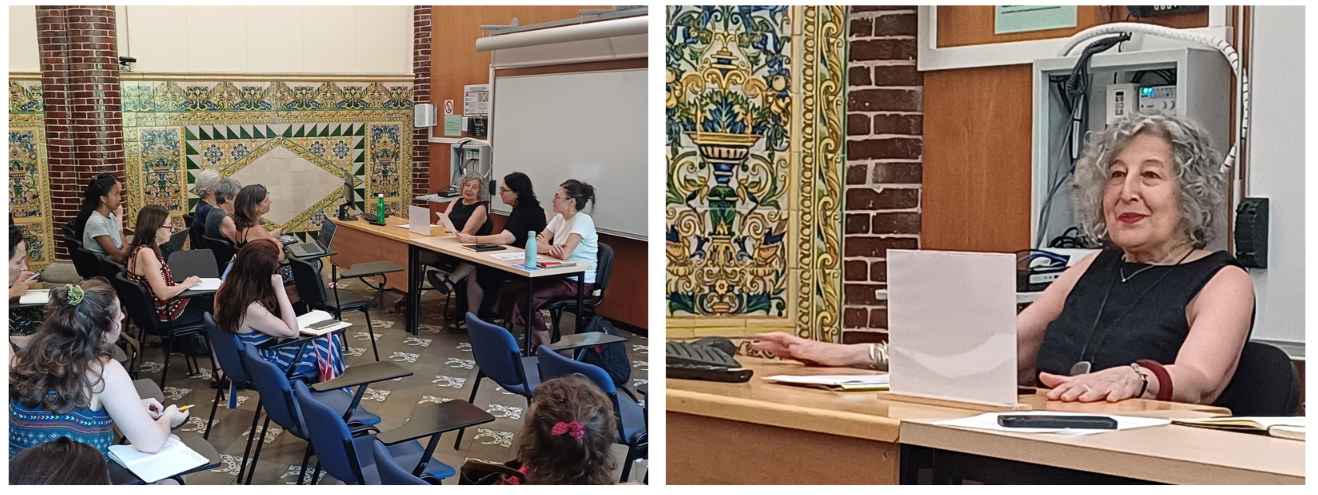
Recap Seminar
During the seminar, Professor Katz introduced the notion of countertopographies as a way to understand how different territories, while geographically distant, are shaped by shared structural processes. This perspective allowed participants to explore how global economic, political and social forces produce uneven childhood experiences across diverse contexts, while remaining deeply interconnected.
A central theme of the discussion was social reproduction and the active role children play within it. Moving beyond dominant narratives that frame children solely as recipients of care and protection, Katz highlighted how children contribute to sustaining everyday life. Their practices, she argued, can also be read as subtle yet powerful forms of resistance within unequal social arrangements.
In the second part of the seminar, KR researchers and doctoral students presented their ongoing research projects, opening up a space for critical dialogue, collective reflection and mutual feedback. These exchanges enabled participants to draw meaningful connections between local experiences across different countries and research contexts involved in the project.
The seminar offered valuable insights for ongoing and future fieldwork, strengthening the analytical tools with which researchers approach childhood, space and inequality.
We warmly thank Cindi Katz for her intellectual generosity and engagement, as well as the nearly 50 participants who joined the session, both in person and online, and contributed to a stimulating and thoughtful exchange.